
How Do Companies Integrate Generative AI into Existing Systems?
As we move deeper into 2026, the conversation around AI has matured. The real challenge now is how to introduce intelligence into existing systems without disrupting what already works.
Most enterprises don’t have the luxury of rebuilding their technology stack from scratch. Their CRMs, ERPs, logistics platforms, and internal tools are deeply embedded in daily operations. This is where generative AI in existing systems becomes relevant and essential.
At Softuvo, we see this shift every day. The most successful organizations are not chasing experimental AI tools. They are focusing on practical, embedded intelligence that improves decisions, reduces manual effort, and scales with their business.
Across industries, enterprises are reaching an inflection point. According to recent enterprise technology studies, over 70% of organizations plan to embed AI capabilities into their existing platforms rather than replacing them entirely. The reason is simple: operational systems have grown around real-world processes, regulatory constraints, and years of institutional knowledge.
Why Integration Matters More Than Reinvention
Replacing stable systems just to “add AI” is expensive, risky, and often unnecessary. Mature organizations are opting for generative AI integration over replacement because it delivers value more quickly and with significantly less operational risk.
By embedding large language models (LLMs) like GPT-4, Claude, or Gemini into existing workflows, companies can:
Automate repetitive knowledge tasks
Enhance decision support inside familiar tools
Improve customer and employee experiences
Preserve years of operational logic and data
This approach turns AI into an extension of the system, not a disconnected layer.
A Practical Roadmap for Generative AI Implementation
Successful AI adoption is not about plugging in an API and hoping for results. In practice, effective implementation of generative AI follows a structured, incremental path.
1. Start with High-Impact, Low-Risk Use Cases
The first step is not technology; it’s prioritization. Organizations that succeed begin with workflows where AI can clearly assist without introducing risk.
Common starting points include
Customer support ticket summarization inside CRMs
Automated report summaries for operations teams
Content assistance within CMS and internal portals
Knowledge retrieval for sales or service teams
These pilots help validate value before broader rollout.
2. Design Around AI APIs and Models Integration
Modern AI adoption is built on modularity. Instead of hard-coding AI logic into core systems, companies adopt an API-first approach.
With clean AI APIs and model integration:
AI services remain loosely coupled to core systems
Models can be upgraded or swapped without re-engineering
Security boundaries are clearly defined
Scalability becomes predictable
This architecture protects the stability of existing platforms while enabling continuous AI evolution.
3. Prepare the Data Layer for Intelligence
AI does not fix poor data. In fact, it amplifies it.
Most legacy environments struggle with:
Siloed databases
Inconsistent formats
Unstructured documentation
Data preparation is a cornerstone of successful generative AI implementation. At Softuvo, this process typically involves:
Data normalization and governance
Secure data access layers
Retrieval-Augmented Generation (RAG) using vector databases
Clear boundaries between private and public data
The result is AI that understands your business, not just generic language patterns.
4. Keep Humans in the Loop
AI should support decisions, not silently replace them.
Enterprise-grade generative AI integration includes:
Review and approval workflows
Confidence indicators for AI outputs
Clear explainability for recommendations
Guardrails against hallucinations and misuse
This balance builds trust and accelerates adoption across teams.
Risk, Compliance & Governance
In regulated industries, governance is not optional. Enterprises implementing generative AI programs must address auditability, explainability, and accountability from day one.
Best-in-class organizations implement:
Role-based access to AI outputs
Logging of AI prompts and responses
Approval checkpoints for sensitive actions
Clear ownership of AI-assisted decisions
This governance layer ensures AI enhances judgment rather than obscuring responsibility. It also enables legal, compliance, and risk teams to support adoption instead of slowing it down.
Real Challenges Companies Face
Even with strong intent, many initiatives fail due to avoidable issues:
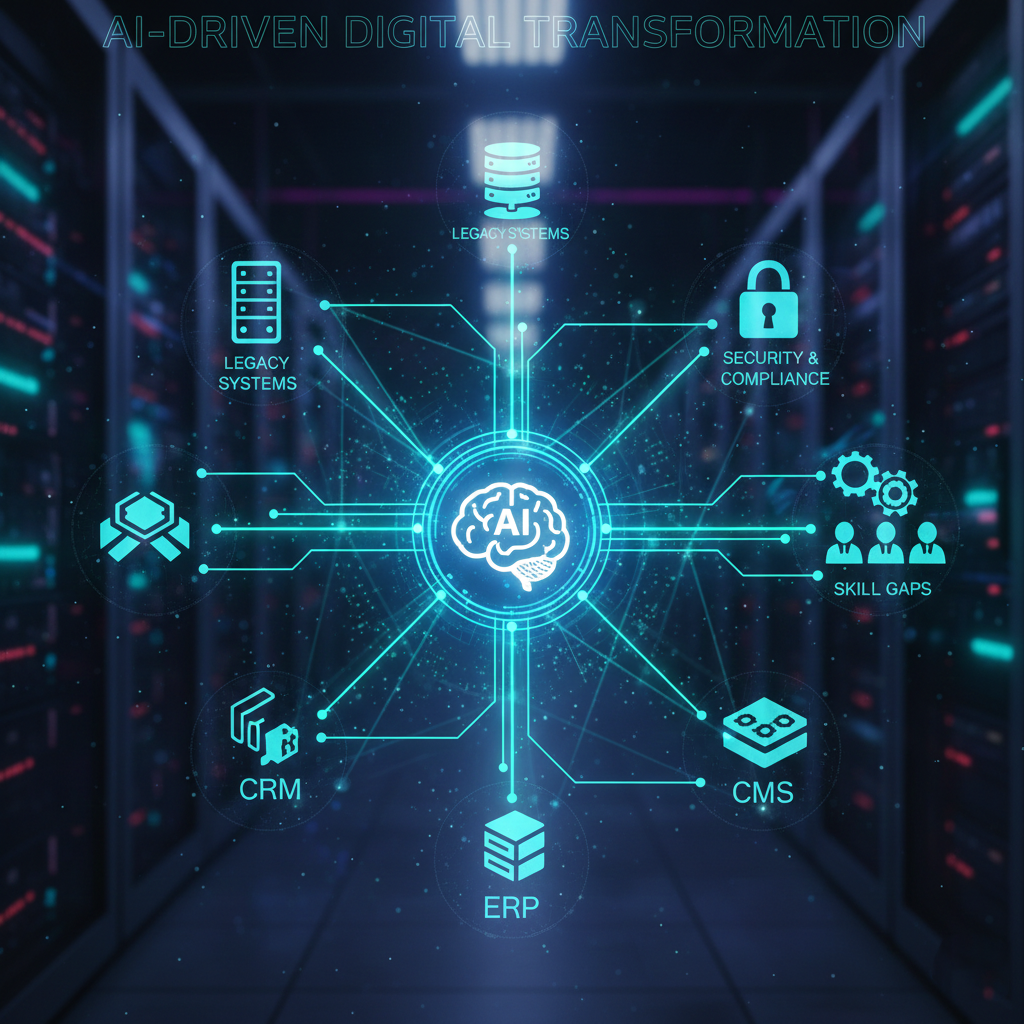
Legacy constraints that lack modern integration points
Security and compliance concerns around sensitive data
Skill gaps between AI theory and production engineering
Overambitious rollouts without validation
These challenges are not theoretical; they are operational. Addressing them early is the difference between progress and stalled pilots.
Here's an image showing the interconnected nature of modern enterprise AI:
How Softuvo Approaches AI-Driven Digital Transformation
At Softuvo, we don’t treat AI as a feature. We treat it as a capability that must coexist with real systems, real users, and real constraints.
Our work in AI-driven digital transformation focuses on:
Identifying where intelligence creates measurable ROI
Designing secure, scalable integration architectures
Embedding AI directly into existing workflows
Aligning AI outputs with operational decision-making
Our strategy integrates AI directly into business operations, from logistics platforms to enterprise dashboards, making it a core functional element rather than a separate experimental project.
Looking Ahead: Integration as a Competitive Advantage
In 2026 and beyond, competitive advantage will not come from who uses AI, but from who integrates it best.
Organizations that embed intelligence into their existing systems:
Move faster without breaking operations
Empower teams with better decisions
Reduce cost through automation
Scale innovation without chaos
The genuine potential resides in the integration of generative AI.
Forward-Looking Insight
Looking ahead, enterprises are moving toward agent-assisted systems, where AI supports planning, monitoring, and exception handling in real time. However, even these advanced patterns depend on strong foundations, clean data, stable integrations, and trusted workflows.
The organizations that prepare now by embedding AI into their existing systems will be best positioned to adopt more autonomous capabilities later, without operational disruption.
Final Thought:
Build Intelligence Where Work Already Happens
The future of enterprise AI is not standalone tools. It’s intelligence woven into the systems people already trust.
At Softuvo, we transform the intention of adopting generative AI into actual execution. We develop practical, secure, and scalable systems for its implementation that deliver tangible results and drive real outcomes for organizations.
If you’re exploring how to bring AI into your existing platforms without disrupting your business, that’s a conversation worth having.